

Structuring a Next.js Project as a Monorepo: Best Practices and Experience Feedback
How to organize a Next.js project in a monorepo architecture? Advantages, tools, folder structure, and advice from my experience on high-volume applications.
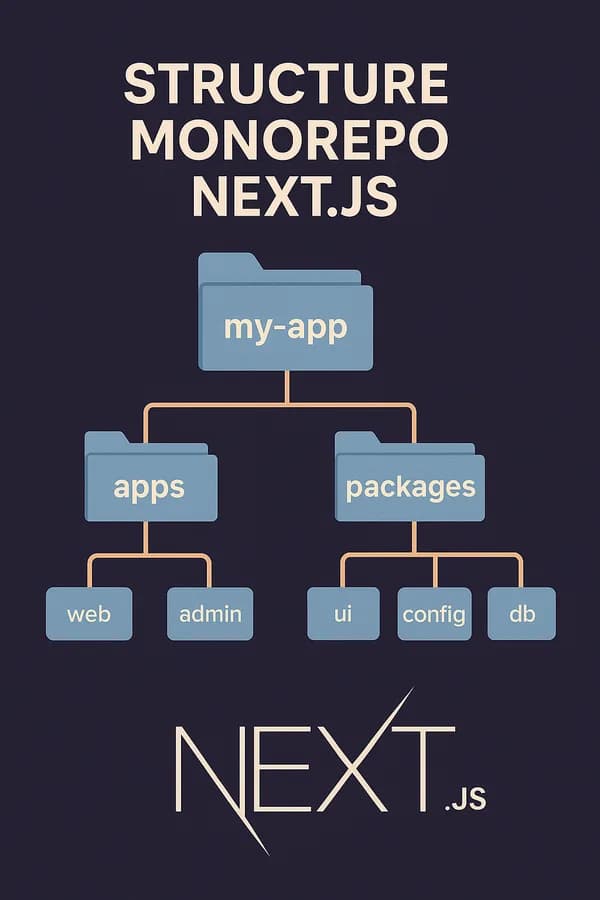
When developing a Next.js application that will grow over time — with multiple modules, backends, shared components — a monorepo architecture quickly becomes a necessity. After several projects, I'm sharing here my best practices for structuring a Next.js project in a clean, maintainable, and scalable monorepo. On the data side, I explain elsewhere why I use Next.js and Drizzle ORM.
📦 Why Switch to Monorepo?
- Centralize frontend, API, shared libraries
- Reduce code duplication (types, business logic)
- Simplify updates across all modules
- Better manage permissions / CI / tests
A well-structured monorepo also allows multiple people to work without overwriting other modules.
🧰 Recommended Tools
- Turborepo (or Nx) for cached builds
- pnpm with workspaces for fast dependency resolution
- TypeScript with
projectReferences - ESLint + Prettier configured at root level
📁 Basic Structure of a Next.js Monorepo
my-app/
├── apps/
│   ├── web/         → main Next.js app
│   └── admin/       → admin interface
├── packages/
│   ├── ui/          → shared components (design system)
│   ├── config/      → Tailwind, ESLint config, etc.
│   └── db/          → ORM, Drizzle schemas, DB helpers
├── .gitignore
├── package.json
├── turbo.json
└── tsconfig.json
Each sub-project can have its own dependencies while accessing common packages via workspaces.
🔄 Usage Example: Shared Components
The packages/ui folder contains components like <Button />, <Card />, <Layout />, all written in TypeScript and styled with Tailwind.
// packages/ui/button.tsx
export function Button({ children }) {
  return (
    <button className="rounded-xl px-4 py-2 bg-orange-500 text-white">
      {children}
    </button>
  );
}
Then, you import it from apps/web:
import { Button } from '@ui/button';
🧪 Tests and Shared Typing
In packages/types, I place all my shared types between frontend, backend, and API. This allows strict typing, especially for data retrieved with Drizzle ORM.
For tests, each app can embed its own Jest/Vitest, or we can share helpers in packages/test-utils.
🚀 Deployment and CI/CD
- Vercel natively supports Turborepo
- Github Actions or Husky to validate PRs
- Deployment per app (web, admin…) targeting only what changed
🎯 What a Well-Structured Monorepo Changes for My Clients
- Easier maintenance, even with multiple apps
- Single source of truth for types, components, functions
- Visual and technical consistency across the entire product
- Real scalability in the long term
📩 Want a Clean Architecture from the Start?
I support startups and ambitious web projects in their technical structuring, whether in creation or redesign. That is the core of my web application and SaaS development work.
👉 Discover my technical SEO services
👉 Contact me directly
👉 Schedule a 30-minute call
A project in mind? A 30-minute call is enough to know whether I am the right person.
Book a 30-min call