How Much Does a Professional Showcase Website Cost with a Freelancer? The Budget Items You Need to Know
Understand the cost of a freelance showcase website item by item: design, development, content, annual fees. Learn how to read a quote and prepare your project in Chartres.
A showcase website quote should be read line by line, not as a lump sum
The cost of a freelance showcase website can't be boiled down to a single figure. You understand it line by line.

So this article doesn't offer a price list. It gives you a method for reading a showcase website quote and understanding what you're paying for.
I'm Mohamad Al-Khatib, a freelance web developer in Eure-et-Loir (MK-Web). By the end, you'll know which questions to ask and how to prepare your project so you can get quotes you can actually compare.
Why the cost of a showcase website varies so much from one project to another
Two showcase websites can go by the same name and have almost nothing in common. The price of a professional showcase website depends first on scope, not on the label.
Five factors weigh on your website budget:
- the number of pages to design;
- the level of design customization;
- features: forms, appointment booking;
- content: existing text and photos, or content that has to be produced;
- deadlines, especially tight ones.
Let's look at two cases.
A baker in Chartres wants five pages: home, products, opening hours, contact, about. The content is simple, and a contact form is enough. The scope is clear and quickly defined.
A professional practice has different needs. It requires online appointment booking, pages for each specialty, carefully drafted legal notices and rigorous handling of personal data. There's more logic to develop, more testing, more sign-offs.
Both are showcase websites. The work involved is not the same.
The main budget items for a showcase website
Your website budget breaks down into five items:
- Design: mockup, visual identity, mobile adaptation.
- Development: the technical build of the showcase website.
- Content and SEO: text, photos, local SEO basics.
- Launch: setup, testing, publication.
- Recurring costs: domain, hosting, maintenance.
Each item is detailed in the following sections. A good quote separates them clearly, line by line. That way you can see what you're paying for, and compare like for like.
Design: mockup, identity, mobile adaptation
Design time covers three areas.
The mockup. This is the visual blueprint of each page, approved before any development begins. It lets you fix the structure and messaging while changes are still quick and inexpensive.
The visual identity. With an existing logo and a clear brand guide (colors, fonts, usage), the work is limited to applying them. Without those, they have to be created or reworked, which adds rounds of back-and-forth.
Mobile and tablet adaptation. Responsive design means thinking through each page for several screen sizes, not just shrinking the desktop version. Check that the quote mentions it.
The more your brand elements are ready, the less time the design takes.
Development: custom-built showcase website or WordPress
Does a custom-built site necessarily cost more? Not always. It all depends on what you ask of the site.
WordPress gets you started quickly. Themes and plugins cover a standard showcase website without starting from scratch. For a standard need, it's often a reasonable choice, and I'll say so plainly.
The trade-off comes later. Each plugin adds code to load, and so affects performance. Each plugin also needs updates, which increases the maintenance workload.
A custom build requires more scoping up front. In return, you get code limited to the essentials, faster to load and easier to evolve without working around a theme.
To choose between a custom-built showcase website and WordPress, ask yourself three questions:
- Is the design standard, or very specific?
- Who will update the content, and how often?
- Will the site need to grow to include specific features?
If your needs are simple and stable, a ready-made solution is enough. If the site has to support your conversions and evolve, a custom build becomes justifiable.
Content and basic SEO: text, photos, local SEO
Text and photos are often the item that's least well costed. The first question to ask: who provides what?
- You provide everything: the quote covers integration and layout.
- Copywriting by the provider: writing and proofreading time is added, with a defined number of revision rounds.
- Photos: your existing images, a stock photo library, or a photographer's shoot. These are three distinct budgets.
Real photos of your business are more reassuring than a generic image.
The local SEO foundation, for its part, should be part of any showcase website build in Chartres:
- title and description tags specific to each page;
- a clear structure, with one main heading per page;
- a completed Google Business Profile linked to the site;
- identical information everywhere: name, address, phone number, opening hours.
For a shop owner in Chartres, a page that states exactly which area you serve helps visitors and search engines understand where you work. It remains a foundation: no ranking is promised.
Hosting, domain name, maintenance: the costs that come back
Once the site is live, some costs come back every year. They're small compared with the build, but you need to plan for them in your annual website costs:
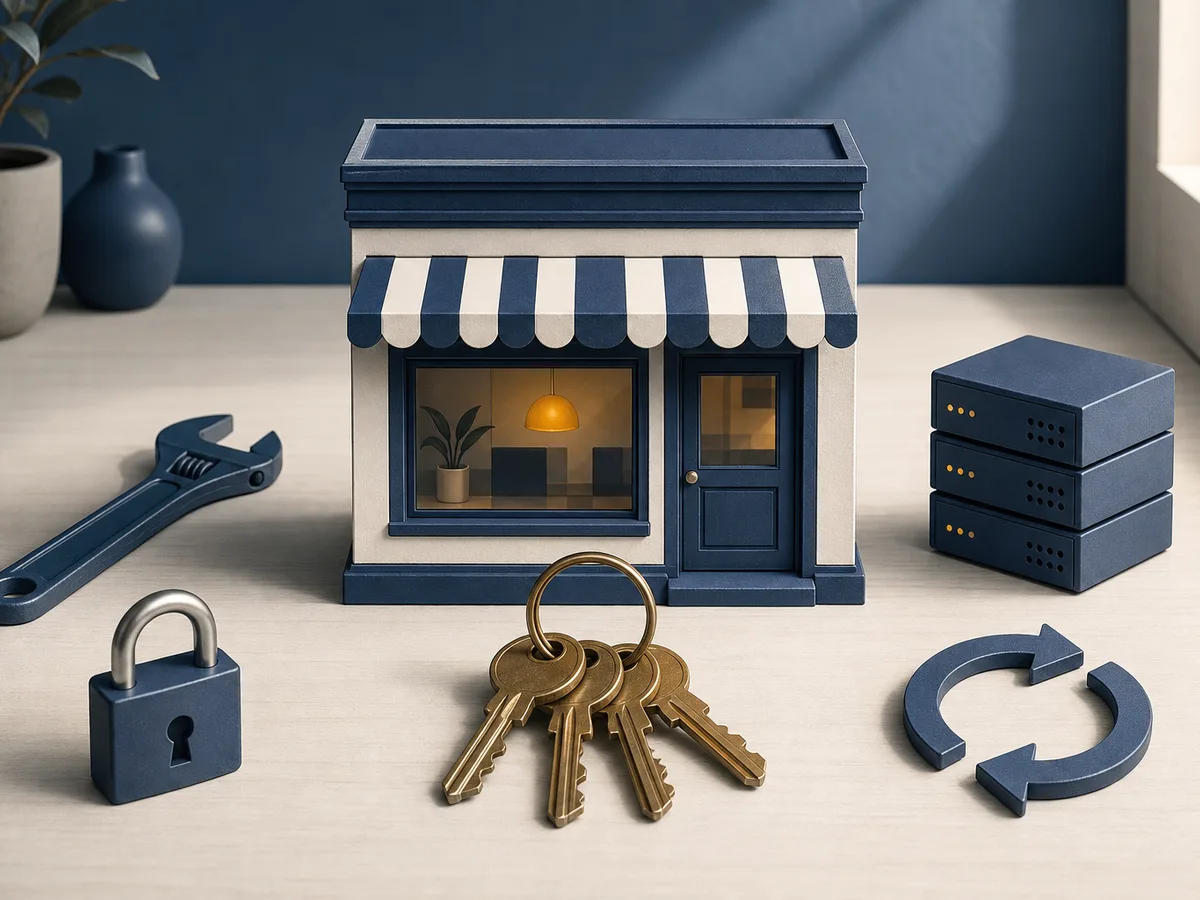
- the domain name, which has to be renewed;
- web hosting, which keeps the site running;
- showcase website maintenance: updates, security patches;
- backups, which are essential for restoring the site after a failure or a hack.
Without maintenance, a site ages quickly and becomes vulnerable. Ask what the quote includes and what is billed separately.
On the legal side, the site must display legal notices and comply with the GDPR: privacy policy, cookie management, information about your forms.
One last point: check who holds the domain and the hosting. They should be in your name, with your own access. Otherwise, you depend on your provider to get your site back.
How long to allow for building a showcase website
The timeline for building a small business website has no fixed value. It depends on the scope and on the pace of both parties.
The stages stay the same:
- scoping, based on a lightweight brief;
- mockup;
- development;
- acceptance testing, meaning tests and fixes;
- launch.
Two things above all stretch a project: content that arrives late, and late approvals that force you to redo a stage that was already finished.
A schedule is therefore built by both sides together. Decide from the start who approves what, and by which date.
Freelancer or agency: what changes on a quote
Between a freelance web developer in Eure-et-Loir and an agency, the site can be the same. What changes is the organization, and therefore how you read the quote.
With a freelancer, you have a single point of contact. They design, develop and oversee the project. Overheads are generally lighter, and communication is direct.
An agency divides up the roles: project manager, designer, developer. This adds coordination, which shows up in the quote, but it allows several workstreams to run in parallel.
In a quote, look at how the time is split: design, development, project management, acceptance testing. A project management line isn't a flaw. It just needs to be clear.
An agency is better suited to a large project, a tight schedule or when several areas of expertise are needed. For a well-defined showcase website, the choice between a freelancer and a web agency depends mostly on your scope.
How to prepare your project to get a fair, comparable quote
A showcase website quote is only comparable if every provider starts from the same brief. A page of notes is enough; it's a lightweight brief.
Here's what it should contain:
- Goals: phone calls, appointment requests, brand image.
- Desired pages: a list, even a provisional one.
- Websites you like: two or three, with what appeals to you about them.
- Available content: text, photos, logo, brand guidelines.
- Deadlines: a desired launch date and the reasons for it.
- Approximate budget: a range, to frame the trade-offs.
- After launch: maintenance, updates, planned changes.
Then send this document to each freelancer. And ask them all the same questions:
- What does the quote include, line by line?
- How many rounds of revisions are included?
- Who writes the copy and supplies the images?
- Who owns the domain name and the hosting?
- Which costs recur every year?
A quote for a showcase website then becomes easy to read. You compare scopes, not just totals.
A showcase website in Chartres and Eure-et-Loir: where to start?
A plumber in Dreux, a shop in downtown Chartres, a physiotherapy practice in Châteaudun: three projects, three needs. The first wants to be found and called. The shop wants to show its products and opening hours. The practice wants to make booking appointments easier.
For a showcase website in Chartres, the starting point is the same: a scoping conversation. It's where we clarify your goals, the content you already have, and your priorities.
As a freelance web developer in Eure-et-Loir, I offer this conversation through MK-Web. Mohamad Al-Khatib answers you directly. The approach is pragmatic and iterative: we start with the essentials, then adjust. No results are promised, but you leave with a clear scope.
FAQ: three common questions
Is one free quote comparable to another? Only if the scope is the same. Compare the line items, not the total: pages, features, content, maintenance.
Do you need to plan everything from the start? No. Fix the essentials and list the rest as options. A clear quote for a showcase website separates the two.
Can the site be expanded later? Yes, as long as the foundations are maintainable. Add pages or features in iterations.